Standing Table I
Question
Three legs are attached to a round tabletop at points chosen independently and uniformly at random around its edge. What is the probability that the table stands?
Solution
Try it yourself first. Open a hint if you get stuck.
Hint 1
The table stands exactly when the centre of the tabletop lies inside the triangle formed by the three legs.
Hint 2
Fix the first leg. Measure the second leg by the angle between them along the shorter arc. Where can the third leg go?
Show solution
When does it stand? The table's weight acts at the centre . It stands exactly when is inside the triangle formed by the three legs. (Cases where lands exactly on an edge have probability .)
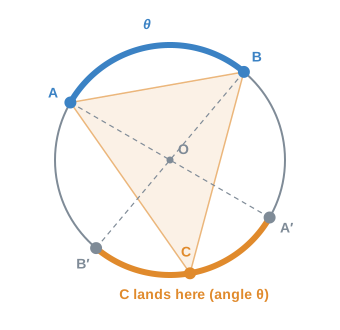
Fix the first two legs. Put leg anywhere. Measure leg by the angle from along the shorter arc, so . Whether is clockwise or anticlockwise of doesn't matter by symmetry, so is uniform on .
Where must the third leg go? Let and be the points directly opposite and . The triangle contains exactly when leg lands on the arc between and , the one facing the short arc . If lands anywhere else, all three legs fit in one half of the table and is outside the triangle. That arc has angle , so
Average over . Since is uniform on ,
so
Answer: .
Quick check: the table falls exactly when all three legs fit in some half of the table. For random points on a circle that happens with probability , which is for . That leaves .