Breaking a Stick into a Triangle II
题目
A stick of length is broken at a point chosen uniformly at random. Then the longer of the two pieces is broken again, at a point chosen uniformly at random along it. What is the probability that the three pieces can form a triangle?
解析
先自己试一试,卡住了再打开提示。
提示 1
As in part I, three pieces adding up to form a triangle exactly when every piece is shorter than .
提示 2
Let be the length of the longer piece after the first break. It is uniform on . For a fixed , where must the second break land?
查看解析
Step 1: The condition. As in part I, three pieces that add up to form a triangle exactly when every piece is shorter than .
Step 2: The first break. Break at , uniform on . The longer piece has length , which is uniform on . The shorter piece, , is already at most , so it never causes a problem.
Step 3: The second break, for a fixed . Break the longer piece at a distance from one end, with uniform on . The two new pieces are and . Both must be shorter than :
That window has length , out of a total length , so
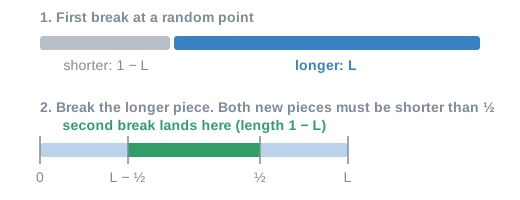
Step 4: Average over . is uniform on , so its density is there:
In the picture below, the curve is the chance of a triangle for each . The answer is its average height over from to : the shaded area divided by the width .
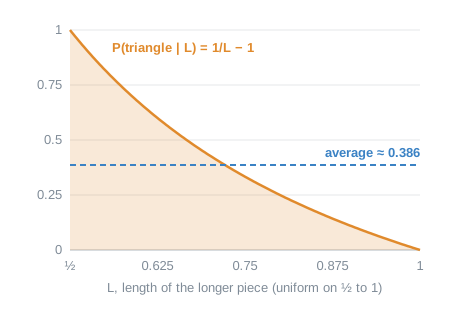
Answer: .
Why it beats part I (): breaking the longer piece avoids the worst case, where both breaks land on the same half and leave one piece longer than .